

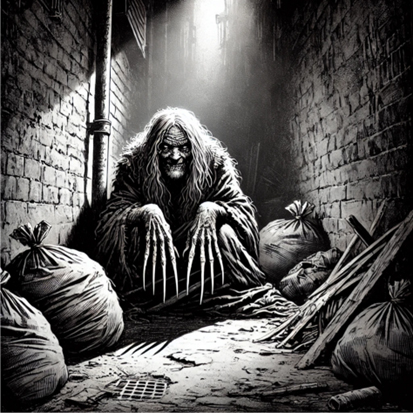
 The house on Maplewood Lane had been empty for years, its windows dark and cracked, its front steps sagging with rot. Children from the neighborhood dared each other to run up to its door on Halloween, to knock three times, to listen for any sounds from within. They all knew the story. They’d heard the whispers about her—the Bag Lady.
She was more than a rumor. A friend’s cousin had sworn he saw her in the attic window one night, her shadowed figure framed by moonlight, a bag tied over her head, her face hidden beneath a shroud of dark cloth. They called her the Bag Lady, though none of them had ever actually seen her face. No one knew why she lived up there, why she only appeared after dark, why people said you could hear her muttering to herself from the street. But there was one rule, a warning passed from kid to kid, whispered in hushed voices on playgrounds and in alleys: don’t look her in the eyes.
Seventeen-year-old Sam didn’t believe in ghost stories. He’d heard the tales of the Bag Lady all his life, how she lived in the abandoned house, how she could freeze you with a look. He thought it was nonsense, something kids made up to scare each other. But one chilly October night, his friends dared him to go inside the house, to find her and prove she wasn’t real.
Sam glanced back at his friends, their faces pale, their eyes wide with a mix of fear and excitement. They huddled near the edge of the driveway, unwilling to get any closer.
“All you have to do is step inside and come back out,” Jake said, a nervous grin on his face. “Easy, right?”
“Come on, it’s just an empty house,” Sam scoffed, though a prickle of dread crept up his spine. He turned, stepping up to the front porch, the wood creaking under his weight, the wind whispering through the cracked windows. The door was ajar, hanging open as though inviting him in, daring him to enter.
With a deep breath, Sam pushed it open, stepping inside. The house was dark, the air thick with the scent of mildew and dust. The faint light from the street cast eerie shadows across the peeling wallpaper, illuminating faded photos on the walls, furniture draped in old sheets, forgotten remnants of lives long gone.
The silence was almost overwhelming, a heavy, suffocating quiet that filled the air, pressing down on him. He glanced back at the door, at the faint outline of his friends peering in from the street, their faces half-hidden in shadows.
“See?” he called, his voice echoing through the empty halls. “Nothing here!”
But as he turned to leave, he heard it—a faint, shuffling sound, coming from above, from the attic.
He froze, his heart pounding, his breath catching in his throat. The sound was soft, almost like footsteps, moving slowly, deliberately, as though someone were pacing back and forth, just above him. He took a step back, his mind racing, but curiosity tugged at him, urging him forward, pulling him deeper into the house.
Ignoring the dread pooling in his stomach, he moved toward the staircase, his footsteps soft, barely a whisper against the floorboards. He placed one foot on the first step, then another, the creak of the wood echoing through the silence, each step bringing him closer to the attic, to the source of the sound.
The air grew colder as he climbed, each step filling him with a sense of foreboding, a chill that seeped into his bones, that settled in his chest, tightening around his heart. The attic door loomed above him, slightly ajar, a sliver of darkness visible through the crack.
With a deep breath, he pushed the door open, stepping into the attic. The room was dark, filled with boxes and old furniture, draped in sheets, shadows stretching across the floor, twisting into strange shapes that seemed to shift and move. The only light came from a small, dirty window at the far end of the room, casting a faint glow over the space.
And then he saw her.
She was standing in the corner, her back turned to him, her body hunched, her head covered by a large, dark bag, tied tightly around her neck. Her clothes were tattered, hanging loosely from her thin frame, her hands hidden in the folds of fabric.
Sam’s breath hitched, his body frozen, his mind racing. She was real. The Bag Lady was real.
“Hello?” he whispered, his voice barely audible.
She didn’t respond, didn’t move, her form still, almost statuesque, her head tilted slightly, as though listening, waiting. And then, slowly, she began to turn.
Sam’s heart pounded, his instincts screaming at him to run, to leave, but he couldn’t move, his feet rooted to the spot as he watched her turn, as he saw the faint outline of her face beneath the bag, hidden in shadow.
Her movements were slow, deliberate, her head tilting to one side, her body twisting as she faced him. And then, she looked up, her eyes meeting his through the thin fabric of the bag, her gaze piercing, cold, filled with something dark, something that sent chills racing down his spine.
He tried to move, to run, but his body was frozen, paralyzed, his muscles locked in place. He couldn’t look away, couldn’t break the gaze, couldn’t even blink as her eyes held him, as her stare bore into him, filling him with a sense of dread, of horror that he couldn’t escape.
The Bag Lady’s eyes seemed to shimmer, to glow beneath the bag, her gaze sharp, unyielding, as though she could see straight through him, into the deepest parts of his soul. Her lips parted, and she spoke, her voice low, raspy, a sound that filled the air, that echoed through the room, wrapping around him like a shroud.
“You came here… uninvited,” she murmured, her words slow, deliberate, each one filled with a quiet menace. “You looked… you shouldn’t have looked.”
Sam’s heart pounded, his mind screaming at him to run, to fight, but he was trapped, frozen in place, held by her gaze, by the power that radiated from her eyes, a force he couldn’t resist, couldn’t escape.
Her hand reached out, bony fingers emerging from the folds of her sleeves, stretching toward him, inching closer, closer, until they were just inches from his face, from his eyes. He could feel the chill radiating from her touch, a cold that seeped into his skin, that froze him to the core.
And then, in a single, swift movement, she reached up, gripping the edges of the bag over her head, pulling it back, revealing her face.
Sam’s heart stopped, his mind reeling, as he saw her eyes, her face, twisted, distorted, her gaze unyielding, her mouth stretched into a dark, toothless grin, a smile that seemed to stretch across her entire face, her eyes empty, hollow, filled with a darkness that defied understanding.
He tried to scream, but no sound escaped his lips. He was frozen, trapped in her gaze, his mind overwhelmed, his body numb, as though he were sinking into a void, a darkness that wrapped around him, that pulled him deeper, deeper, until he could feel nothing, hear nothing, see nothing but her eyes.
And then, everything went black.
The next morning, Sam’s friends returned to the house, their laughter fading as they saw that he hadn’t come out, hadn’t returned. They stood in silence, staring at the house, their faces filled with fear, with a terrible, gnawing dread.
They called his name, their voices echoing through the empty halls, but there was no answer, no sound, only the faint, eerie silence that filled the house, that pressed down on them, filling them with a sense of unease, of horror.
As they searched, one of them glanced up at the attic window, his breath catching in his throat as he saw something—a figure, half-hidden in the shadows, her head covered by a dark bag, her eyes fixed on him, watching, waiting.
He froze, his body tense, his heart pounding as he stared back, as he felt her gaze, as he felt the chill settling over him, wrapping around him like a shroud.
And then, she raised her hand, a slow, deliberate wave, a gesture filled with a dark, silent promise.
He stumbled back, his face pale, his mind racing, as he turned to his friends, his voice trembling.
“Sam’s… he’s gone. And she… she’s still there.”
The Bag Lady watched them from the window, her figure barely visible, her gaze piercing, unyielding, her presence a shadow that lingered, that haunted, a reminder that the house on Maplewood Lane was not empty, that it held secrets, that it held a darkness that would never fade.
And as the children fled, her gaze followed them, a silent warning, a promise that they would never be safe, that her eyes would always find them, that her darkness would always reach them.
The Bag Lady was real.
And she was waiting.
Word of Sam’s disappearance spread quickly through the neighborhood, whispers of the Bag Lady growing more insistent, more chilling. Some said Sam had run away, tired of the small-town life. But his friends knew the truth—they’d seen her in the attic window, that shadowed figure staring down at them, the Bag Lady’s hand lifting in that slow, ominous wave. Since that day, none of them could sleep, haunted by nightmares of her gaze, of Sam’s frozen expression in their minds, locked in horror.
Jake couldn’t shake the image of her from his mind. He’d been the last one to see her face, even if only from a distance, and every time he closed his eyes, he felt her watching, felt that suffocating cold settle over him, like she was still there, her eyes locked on him. But as scared as he was, he couldn’t let it go. He needed answers. He had to know what had happened to Sam.
That evening, Jake sat on his bed, clutching his phone, scrolling through articles about the house on Maplewood Lane, about disappearances tied to it from years ago, decades even. But no one had documented anything substantial. There were only vague accounts of “odd events,” an urban legend about a woman who “froze people with a glance.” But as he scrolled further, his screen flickered, and a single phrase caught his eye: the curse of the Bag Lady.
The article mentioned rumors from decades ago, stories that claimed a woman had once lived in the house—an outcast, shunned by the town, who wore a bag over her head to hide from the world. They said she had died alone, cursed to remain in the house forever, her gaze twisted into something dark, something deadly. And anyone who looked her in the eyes would be trapped, frozen in place, as her spirit drained them.
Jake’s heart pounded as he read, the words filling him with a growing sense of dread. He couldn’t shake the image of Sam standing in the attic, locked in that twisted gaze. And he knew what he had to do.
That night, he slipped out of his house, the cool autumn air biting at his skin as he made his way toward Maplewood Lane. He tried to keep his breathing steady, his footsteps silent, but every rustle of leaves, every whisper of wind sent chills racing down his spine. He felt as though the shadows themselves were alive, shifting, watching, waiting.
The house loomed before him, its windows dark, the air around it filled with an unnatural stillness. He paused at the edge of the yard, his heart pounding, his mind racing with fear, but he forced himself to move forward, to step up onto the rotting porch.
“Sam,” he whispered, his voice barely audible, though he knew Sam couldn’t hear him, wouldn’t answer. He took a deep breath, his hand reaching for the doorknob, his fingers trembling as he pushed it open, stepping inside.
The house was dark, the silence heavy, pressing down on him, filling the air with a sense of foreboding. He moved slowly, his footsteps echoing through the empty halls, his flashlight casting long shadows that twisted and shifted with each step. The stairs to the attic loomed before him, their wood warped and creaking, leading up into the darkness, to where he knew she was waiting.
As he climbed, a faint sound reached his ears—a soft, whispering voice, drifting through the silence, filling the air with a chill that seeped into his bones. It was a voice unlike anything he’d ever heard, a rasping, echoing sound that seemed to come from everywhere at once.
“Come closer…”
He stopped, his heart pounding, his breath hitching as the voice filled the air, as though it were wrapped around him, pulling him forward, urging him closer to the attic, to the room where she waited. Every instinct screamed at him to turn back, to run, but he was frozen, unable to look away, unable to resist the pull of her voice.
With each step, the voice grew louder, filling his mind, drowning out everything else. He reached the attic door, his hand trembling as he gripped the handle, pushing it open, stepping inside.
The room was dark, filled with shadows that seemed to pulse and breathe, the only light coming from a small, broken window at the far end. And there, in the corner, he saw her.
She was hunched over, her back turned to him, her head covered by the bag, her body wrapped in tattered, dark clothing that draped over her frame, shrouding her in darkness. She didn’t move, didn’t make a sound, but he could feel her presence, heavy and cold, pressing down on him, filling him with a dread he couldn’t shake.
“Sam?” he whispered, his voice trembling, barely audible.
And then, slowly, she turned.
Her movements were slow, deliberate, her head tilting to one side, her body twisting as she faced him, her bag-covered face turning toward him, her gaze piercing, unyielding, as though she could see straight through him, into the deepest parts of his soul.
Jake tried to look away, tried to move, but he was frozen, trapped in her gaze, unable to look away, unable to escape. Her eyes seemed to burn through the fabric of the bag, two dark, empty voids that filled him with a horror he couldn’t understand, a fear that went beyond anything he’d ever felt.
“Why have you come here?” she whispered, her voice low, echoing, a sound that wrapped around him, that pulled him deeper into the darkness, into the cold, suffocating void that radiated from her gaze.
He couldn’t speak, couldn’t breathe, his body numb, his mind trapped, frozen, as her gaze held him, as her eyes bore into him, filling him with a sense of dread, of terror that he couldn’t escape.
The Bag Lady took a step forward, her bony fingers emerging from the folds of her sleeves, reaching toward him, inching closer, closer, until they were just inches from his face. He could feel the chill radiating from her touch, a cold that seeped into his skin, that froze him to the core.
“You wanted to see him?” she murmured, her voice barely a whisper. “Then look.”
She lifted her hand, pointing to the far corner of the attic, where the shadows shifted, revealing a figure—Sam, standing motionless, his eyes wide, his face pale, frozen in horror. His body was stiff, his limbs locked, his expression twisted in a silent scream, as though he’d been trapped in that moment of terror, unable to move, unable to escape.
Jake’s mind reeled, his heart pounding as he realized the truth, as he understood what had happened to Sam, what would happen to him. He was trapped, frozen, held by her gaze, by the power that radiated from her eyes, a force that defied understanding, that held him in place, filling him with a terror that he couldn’t escape.
The Bag Lady’s face twisted into a smile, her eyes gleaming beneath the bag, her expression filled with a dark, twisted satisfaction.
“You came to find him,” she whispered, her voice soft, mocking. “Now… you’ll join him.”
Her gaze held him, unyielding, her eyes piercing, cold, as his vision blurred, as the world faded to black, his body numb, frozen, trapped in the darkness, a darkness that stretched on forever, that held him, that consumed him, as though he were sinking into a void, a void filled with her eyes, her voice, her gaze.
And then, everything went silent.
By morning, rumors of Jake’s disappearance spread through the town, whispers of the Bag Lady growing louder, more insistent. His friends spoke in hushed voices, their faces pale, filled with a growing sense of dread, a fear that settled over them like a dark cloud.
They’d all known the stories, the warnings, the tales of her cursed gaze, but they’d never believed, never thought it was real. But now, with both Sam and Jake gone, the truth settled over them, an undeniable horror that filled them with a terror they couldn’t shake.
One by one, they began to see her, in the attic window, her shadowed figure barely visible, her eyes fixed on them, watching, waiting. And as night fell over the town, they felt her presence, a dark, unyielding force that filled the air, that whispered to them, calling them, drawing them closer, pulling them into the darkness.
The Bag Lady was real.
And she was watching.
The town was changing. Since the disappearances of Sam and Jake, an unsettling atmosphere had taken hold, a fear that seeped into every street, every home. Parents warned their children to stay indoors after dark. Neighbors glanced nervously at each other, exchanging murmurs of unease, as though saying her name aloud might summon her.
People claimed to see her everywhere. A faint shadow in the attic window, a glimpse of dark fabric moving through the trees, a faint voice drifting on the wind, low and raspy, as though calling to them. But the sightings were brief, fleeting, as if the Bag Lady was toying with them, haunting them from the edge of sight.
Rumors spread like wildfire. Some said she was a ghost, a restless spirit bound to the house. Others whispered that she was a curse brought on by the house itself, an ancient evil lurking in the walls. But one thing was certain: no one who went into the house ever came back.
The final straw came one chilly evening when Mrs. Halverson, the elderly woman who lived across the street from the Maplewood house, rushed into the town’s small library, her face pale, her eyes wide with terror. She claimed to have seen the Bag Lady outside her window, standing on the sidewalk, watching her, her bag-covered face turned upward, her dark, unblinking gaze fixed on Mrs. Halverson’s window.
“I saw her,” she whispered, her voice shaking, her hands trembling. “She was just… standing there. Staring, as if she could see right through me.”
Word of Mrs. Halverson’s sighting spread through the town, each person who heard it feeling a cold dread settle over them. That night, the town council called an emergency meeting in the old church, the only place large enough to fit the concerned crowd that gathered, each person filled with a growing sense of fear.
Mayor Whelan, a thin, balding man with worry lines etched deep into his face, stood at the front of the room, his hands clenched tightly around a crumpled sheet of paper, his voice trembling as he addressed the crowd.
“We… we all know why we’re here,” he began, his gaze sweeping over the anxious faces before him. “Sam and Jake are still missing. We’ve heard the rumors, the stories about… about the woman in the Maplewood house. And while I don’t personally believe in ghosts, we can’t ignore what’s been happening.”
An uncomfortable murmur rippled through the crowd, people exchanging glances, fear flickering in their eyes.
“Something has to be done,” called out a voice from the back of the room, an older man with a face set in grim determination. “This house has been haunting us for too long. Whatever’s inside… it’s taken our kids. We can’t just sit back and do nothing.”
Mayor Whelan nodded, his expression somber. “I agree. We need answers. Tomorrow night, I’m organizing a search team. We’ll go into the house and find out once and for all what’s inside.”
The room fell silent, each person absorbing the weight of his words, the knowledge that they would confront the thing that had haunted their town for years.
Mrs. Halverson stood, her voice trembling. “But… but what if she’s real? What if… if she’s waiting for us?”
The mayor’s jaw tightened, his face pale, his eyes filled with fear. “Then we’ll face her. Together.”
The following night, as the sun dipped below the horizon, the town gathered at the edge of Maplewood Lane. The house loomed before them, its windows dark, its walls weathered, draped in shadows. Mayor Whelan led the small group of volunteers, their faces tense, their bodies rigid as they stood at the gate, each one feeling the weight of what they were about to face.
“Let’s get this over with,” the mayor said, his voice barely more than a whisper.
They moved toward the house, their flashlights casting thin beams through the darkness, illuminating the cracked walls, the peeling paint, the broken windows that seemed to watch them as they approached. The air was thick with tension, each step filling them with a growing sense of dread.
As they reached the porch, the wood creaking beneath their feet, they hesitated, glancing at each other, their faces pale, their eyes wide with fear.
And then, slowly, the door opened, swinging inward with a soft, groaning sound, as though the house were inviting them inside, daring them to enter.
Mayor Whelan stepped forward, his flashlight trembling in his hand as he crossed the threshold, the others following close behind. The air was cold, thick with the scent of mildew and dust, the faint sound of whispers drifting through the darkness, filling the silence, wrapping around them like a shroud.
They moved through the house, their flashlights illuminating empty rooms filled with old furniture, faded photographs on the walls, relics of lives long forgotten. But as they reached the staircase, they stopped, their bodies tense, their breaths shallow as they heard it—a faint, shuffling sound, coming from above, from the attic.
Each one felt the weight of her presence pressing down on them, a cold, heavy dread that seeped into their bones, that filled them with a terror they couldn’t shake. They exchanged glances, each one reluctant, but Mayor Whelan squared his shoulders, his jaw set in determination.
“We came here to find answers,” he said, his voice steady, though his face was pale. “We’re not leaving until we know what’s up there.”
They climbed the stairs, each step slow, deliberate, the creak of the wood echoing through the silence, each sound filling them with dread, with a fear that pressed down on them like a heavy weight.
As they reached the attic door, they stopped, their flashlights casting shadows across the dark, worn wood, each one feeling the cold, oppressive presence pressing against them, filling the air, wrapping around them.
Mayor Whelan took a deep breath, his hand trembling as he reached for the doorknob, twisting it, pushing the door open.
The attic was dark, filled with shadows that seemed to pulse, to breathe, the only light coming from a small, broken window at the far end of the room. And there, in the corner, they saw her.
She was hunched over, her back turned to them, her head covered by the bag, her body wrapped in dark, tattered clothing that draped over her frame, her hands folded in her lap. She didn’t move, didn’t make a sound, but they could feel her presence, cold and unyielding, filling the room, pressing down on them, filling them with a horror that went beyond anything they’d ever felt.
Mayor Whelan raised his flashlight, his voice barely a whisper. “Ma’am… we don’t mean any harm. We just want to know what happened to those boys.”
For a moment, she remained still, her form shrouded in shadow, her head tilted downward, her face hidden beneath the bag. But then, slowly, she began to turn.
Her movements were slow, deliberate, each motion filled with a strange grace, a quiet menace that held them frozen, trapped in place, unable to move, unable to look away.
She turned to face them, her bag-covered head tilting upward, her gaze piercing, cold, as though she could see straight through them, into their souls. And then, she lifted her hands, reaching for the edges of the bag, pulling it back, revealing her face.
The volunteers froze, their bodies locked in place, their minds reeling with horror as they saw her eyes—dark, hollow voids that seemed to pull them in, that held them, trapped, paralyzed.
Her gaze pierced each of them, her lips parting in a slow, toothless smile, her face twisted, distorted, filled with a darkness that defied understanding.
One by one, they felt their bodies go numb, their muscles locking, their breath caught in their throats as her gaze held them, as her eyes filled them with a horror that consumed them, that pulled them deeper, deeper into the void.
And then, everything went black.
By morning, the townspeople found the volunteers, each one frozen in place, their bodies locked in expressions of terror, their faces pale, their eyes wide, staring into the distance, as though caught in a moment of unimaginable horror.
They were unresponsive, unable to speak, to move, as though they’d been drained, as though their souls had been trapped in that house, held by her gaze, by the power that lingered in the attic.
And as the town gathered, as they stared at the volunteers’ frozen forms, a cold dread settled over them, a knowledge that filled them with a terror they couldn’t escape.
The Bag Lady was real.
And now, she had more to keep her company.
The town of Maplewood fell into a grim silence in the days following the failed search. The volunteers, those brave souls who had entered the Bag Lady’s house, now lay in the town’s small hospital, their bodies locked in a frozen state of terror. Eyes wide, lips parted in silent screams, they remained completely unresponsive, as if they were statues—trapped, haunted relics of their encounter. The doctors, baffled, could only watch over them in horror, as their vital signs remained steady but unchanging.
Rumors of the Bag Lady’s curse spread faster than the morning papers. Parents forbade their children from going near the house, friends exchanged whispered theories, and even the most skeptical grew uneasy. In the stillness of night, residents claimed they could hear faint, raspy whispers, drifting through the streets, calling their names, beckoning them to come closer.
Pastor Timothy was among the few people who refused to give in to the spreading terror. A young, compassionate man who’d moved to Maplewood only recently, he couldn’t believe that a single house—an old, decrepit building—could hold so much fear over the townsfolk. The story of the Bag Lady seemed, to him, like an old tale spun wildly out of control.
But when he visited the hospital and saw the look of frozen horror on the faces of those volunteers, he felt something new. This was no ordinary fright; this was a fear that ran deeper, something primal. Determined to find a solution, he gathered a small group of people willing to face the Bag Lady once again, this time with a plan: they would consecrate the house, banish whatever spirit lingered there, and, they hoped, free their friends from the curse.
That evening, Pastor Timothy, accompanied by two locals—Mr. Donovan, a retired schoolteacher, and Sarah, a no-nonsense nurse from the hospital—prepared to confront the Bag Lady. Armed with candles, holy water, and old purification salts from the church, they approached the house with cautious determination.
“Remember,” Pastor Timothy whispered as they reached the doorstep, “we stick together. Don’t look directly at her face. We’ve been warned enough—keep your eyes low, and trust that we’re here for the right reasons.”
The others nodded, though their faces were pale, each one fighting a rising dread.
They stepped inside, the air thick with the familiar, oppressive silence. Shadows hung heavily over every corner, the rooms filled with stale air and a lingering scent of decay. They moved slowly, their flashlights flickering across the walls, the beams catching dust motes that drifted lazily in the heavy air.
They passed through the downstairs rooms, murmuring prayers, sprinkling holy water, marking the doorframes with salt. Pastor Timothy’s voice was steady, his presence grounding, but as they climbed the stairs to the attic, the silence grew thicker, heavier, each step a struggle against the oppressive atmosphere that seemed to cling to them.
At the top of the stairs, they paused, each of them feeling a cold chill that seeped into their bones, a dread that whispered of things unseen, of horrors waiting in the darkness. The attic door stood before them, slightly ajar, as though inviting them in, daring them to step forward.
Pastor Timothy took a deep breath, his hand steady as he pushed the door open, his flashlight illuminating the dusty, cluttered space. The room was empty, save for the old furniture covered in sheets, the dusty boxes piled in the corner, and the faint, lingering scent of something rotten.
And then they saw her.
The Bag Lady stood in the far corner, her back turned to them, her hunched form shrouded in dark fabric, her head covered by the infamous bag, tied tightly around her neck. She was still, unmoving, but the weight of her presence filled the room, pressing down on them, a cold, unyielding force that seeped into their skin, into their minds.
Pastor Timothy began to speak, his voice steady, reciting an ancient prayer of exorcism, his words echoing through the silence, filling the room with a strange, pulsing energy.
But as he spoke, she began to turn.
Her movements were slow, deliberate, each motion filled with an unnatural grace, her head tilting to one side, her body twisting as she faced them. Her bag-covered face seemed to radiate a dark, sinister energy, an invisible force that held them frozen, unable to look away.
“Do not look,” Pastor Timothy whispered, his voice trembling as he stared at the floor, fighting against the pull of her gaze. “Don’t meet her eyes.”
Mr. Donovan and Sarah obeyed, their eyes fixed firmly on the floor, their bodies tense, their breaths shallow, but the Bag Lady’s presence filled the room, pressing against them, filling them with a dread that went beyond fear, a terror that gnawed at their minds, their souls.
Her voice broke the silence, a low, raspy whisper that seemed to seep into their bones, chilling them to the core. “You come here… uninvited,” she murmured, her words echoing through the room. “You think you can rid me of my home?”
Pastor Timothy continued his prayer, his voice trembling but unwavering. “In the name of all that is holy, I command you to leave this place, to release your hold on those you have taken.”
She laughed, a low, hollow sound that filled the air, her head tilting as though in amusement. “You cannot command me,” she whispered, her voice soft, mocking. “This place is mine. They are mine.”
Her hands lifted, pale and bony, reaching for the edges of the bag, her fingers curling around the fabric, pulling it back. Pastor Timothy clenched his eyes shut, his breath hitching, as he sensed the change in the room, as he felt the weight of her gaze pressing down on him, filling him with a terror he couldn’t escape.
Sarah’s voice was a faint, trembling whisper. “Pastor… we need to leave.”
But it was too late.
The Bag Lady pulled the bag from her head, revealing her face—a face twisted, distorted, hollow eyes fixed on them, dark voids that seemed to pull them in, to hold them, freezing them in place, trapping them in her gaze. Mr. Donovan gasped, his body going rigid, his mouth open in a silent scream as her eyes met his, as her gaze held him, locked him in place.
Pastor Timothy felt the chill creep over him, the numbness settling into his bones, his voice faltering as he struggled to look away, to break free from her gaze. But her eyes held him, unyielding, filling him with a darkness that seeped into his mind, drowning him in a sea of fear, of despair.
The Bag Lady smiled, a slow, twisted smile that stretched across her face, her hollow eyes gleaming with satisfaction, with a dark, malevolent joy.
“You cannot take what belongs to me,” she whispered, her voice soft, final. “This place… these souls… they are mine.”
And then, everything went black.
When the townspeople found Pastor Timothy, Mr. Donovan, and Sarah the next morning, they were standing motionless in the attic, their faces frozen in terror, their eyes wide, staring into the darkness, trapped in that same, horrific state as the others who had entered the house before them.
News of the failed exorcism spread, each new detail adding to the growing sense of horror that filled the town. People avoided the street altogether, refusing to go near the house, even in broad daylight. Schools closed early, businesses shuttered, and an unspoken rule fell over Maplewood: stay away from the Bag Lady’s house.
But the sightings continued. Children claimed to see her wandering the streets at night, her dark figure moving silently, her eyes fixed on them, watching, waiting. Others swore they heard her whispers drifting through the town, calling their names, filling the air with an eerie, oppressive presence that lingered long after the sun rose.
Some families left town, unwilling to stay in a place haunted by such a dark, malevolent force. Others huddled in their homes, praying, hoping that she wouldn’t come for them, that they wouldn’t be the next to disappear.
And in the heart of Maplewood, the Bag Lady watched from her window, her hollow eyes fixed on the town, her gaze unyielding, her presence a constant reminder of the darkness that lingered, that haunted every street, every home.
As night fell over the town, the whispers grew louder, filling the air, a haunting echo that drifted through the darkness, a reminder that she was still there, waiting, watching, her curse spreading like a shadow over Maplewood.
The Bag Lady had claimed her home, her souls, and she wasn’t finished.
And as the people of Maplewood lay awake in their beds, dreading the sound of footsteps outside, the faint whisper of her voice, they knew one thing for certain.
The Bag Lady was real.
And she would never leave.
The terror gripping Maplewood was palpable, a thick, unseen presence that seeped into the very air. People spoke in hushed tones, casting nervous glances over their shoulders, avoiding the house on Maplewood Lane like the plague. But no matter how hard they tried, they couldn’t escape the Bag Lady. She lingered in every darkened window, every creak of the floorboards at night, every chill that prickled the skin unexpectedly.
Desperation grew. Some residents pleaded with the town council to demolish the house, believing that destroying it might somehow release her hold over them. But each time they sent contractors or city workers, they would return, shaken and pale, claiming the house felt “wrong,” as though it were somehow pushing them away, refusing to let them enter.
Amid the rising fear, there was one person who believed she might have answers: Mara Graves, an elderly woman who had lived in Maplewood for nearly eighty years. She was rarely seen outside her home these days, her body weakened by age, but she was known for her vast knowledge of the town’s history—and for her strange connection to the Bag Lady’s past.
When rumors spread that Mara might know something, a small group of the remaining residents gathered enough courage to approach her. They visited her on a quiet afternoon, the sky overcast, the town blanketed in a subdued, eerie silence. They found her sitting by the window, staring out at the street with a knowing look, her hands folded in her lap.
“You’ve come about her, haven’t you?” Mara said, her voice soft, almost resigned.
The group exchanged wary glances, nodding.
Mara sighed, her gaze distant, her voice tinged with sorrow. “They called her Ethel Baker. But long before she became the Bag Lady, she was just a girl, lost and broken by this town.”
According to Mara, Ethel had once been a resident of Maplewood, but her life had been filled with hardship. Her family was poor, her father a drifter and her mother frail. Ethel was ridiculed in school, mocked by her peers, whispered about by the townsfolk who claimed her family was cursed. She was lonely, withdrawn, a shadow in the background of the town’s bustling life.
As a teenager, she fell in love with a young man, the son of a well-to-do family. But when his parents discovered their relationship, they forbade him from seeing her, and rumors spread quickly that she had “bewitched” him. People began to avoid her, crossing the street whenever she walked by, muttering about her in the church pews, casting her out like an unwelcome spirit.
Her life spiraled into despair. Isolated, her heart hardened, and over time, her presence in Maplewood became something of a ghost story. Children claimed they saw her lingering on street corners, muttering to herself, her eyes hollow and dark. Eventually, she moved into the house on Maplewood Lane, sealing herself away from the world.
But the final breaking point came one winter night when a group of townsfolk, fed up with her “haunting” presence, broke into her home. They dragged her out, shouting curses, calling her a witch. In their blind fury, they tied a bag over her head, leaving her stranded, humiliated, in the street as the townspeople watched.
Mara’s voice trembled as she spoke, her eyes glistening with tears. “The next morning, Ethel was gone. No one saw her again. Some said she left town, others that she’d taken her own life. But the truth was far darker. She died that night, trapped by the hate and cruelty of those who had cast her out.”
The room fell silent, the horror of Ethel’s fate settling over them like a dark cloud. Mara’s gaze turned hard, her voice a low whisper. “When she died, her spirit became bound to the house. She was filled with anger, with sorrow… with the darkness that the town had forced upon her. And now, her curse lingers, her spirit bound to the house, drawing in anyone foolish enough to enter.”
One of the townsfolk, a young man named Peter, cleared his throat, his face pale. “But… is there a way to break it? To free her? So she’ll stop… taking people?”
Mara’s gaze shifted, her eyes filled with a mix of hope and sorrow. “There is one way. Her spirit seeks peace, to be remembered not as the monster they made her into, but as the girl she once was. If you can find her belongings—the things that meant something to her—and return them to the house with respect, with forgiveness, you may be able to appease her.”
Determined to end the curse, a few brave souls from Maplewood set out to locate Ethel’s belongings. Mara provided them with clues, mentioning that Ethel had kept a small diary, her most cherished possession, filled with poetry and thoughts she’d never shared with anyone. She’d also owned a locket, given to her by her mother, a delicate piece with a faded photograph inside.
The group split up, searching abandoned buildings, the town’s archives, and old storage rooms. Days passed, and tensions grew as more people began to see the Bag Lady’s dark figure in their windows, standing silently in the streets, her gaze unblinking, as if waiting.
Finally, after countless hours of searching, they found the diary in an old box in the town library, hidden among dusty books and forgotten papers. The locket took longer, but they eventually located it in a box of belongings left in an old storage closet of the town’s church.
With these items in hand, the group prepared to return to the house, hopeful that this would be enough to end the Bag Lady’s haunting.
On a moonless night, a small group gathered outside the house, Mara among them, her hands steady despite the gravity of what they were about to attempt. She directed them on how to proceed: place the diary and the locket in the attic, where Ethel had spent her last days, and light a candle for her, offering her the peace she had been denied.
They moved through the house, their steps soft, respectful, each one feeling the weight of her story, of her sorrow. As they reached the attic, they arranged the items carefully on the floor, placing the diary beside the locket, lighting a candle to honor her memory.
Mara’s voice trembled as she spoke, addressing the Bag Lady directly. “Ethel… we know what happened to you. We’re sorry. You didn’t deserve the hate, the fear. Please, find peace.”
A hush fell over the room, the air thick with anticipation, with a sense of quiet that felt almost sacred. The candle flickered, casting long shadows over the walls, illuminating the space with a soft, warm glow.
And then, in the corner of the attic, a figure appeared.
The Bag Lady stood there, her head still covered by the bag, her body hunched, her presence filling the room. But something had changed. Her form seemed less solid, almost ethereal, her posture less threatening, her gaze softer. She moved forward, reaching out to the items they had left for her, her hand trembling as she touched the locket, as she traced her fingers over the worn cover of her diary.
For a moment, the room was silent, the air filled with a quiet reverence as the townsfolk watched, their hearts pounding, their breaths shallow.
And then, slowly, she lifted her head, her hollow eyes meeting theirs. There was no malice in her gaze, only sorrow, a deep, aching sadness that filled the room, that seeped into their hearts, as though she were sharing her pain, her suffering, for the first time.
She turned, her form dissolving into shadows, the darkness lifting, dissipating, as though her spirit were finally at peace, finally freed from the chains that had bound her to the house.
The candle flickered one last time, then went out, leaving them in darkness, a silence that felt different—lighter, almost peaceful.
In the days that followed, the Bag Lady’s presence faded from Maplewood. The sightings stopped, the whispers quieted, and the house on Maplewood Lane became just another empty building, no longer haunted by the shadows of the past.
People spoke of Ethel with compassion, remembering her not as a ghost, but as a girl lost to the cruelty of a fearful town. They honored her memory, leaving flowers at the house, ensuring she was never forgotten.
And as the years passed, the legend of the Bag Lady faded, her story becoming part of the town’s history, a reminder of the darkness that can be born of hatred, and the peace that comes from understanding, from forgiveness.
The house remained empty, but it was no longer feared. And Ethel, the girl who had once been known as the Bag Lady, was finally at rest.
The End
