

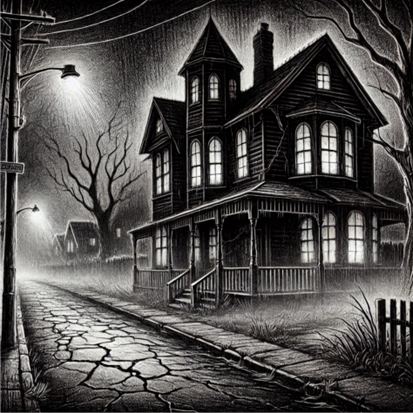
 The house on Maple Street had been the source of rumors in Briar Glen for as long as anyone could remember. It sat at the edge of town, a looming, decaying Victorian with peeling paint and boarded-up windows, its presence an ominous silhouette against the northern sky. No one dared approach it after dark, and even during the day, few lingered near its crumbling steps. Parents warned their children to stay away from it, yet the dare to visit its eerie halls was irresistible to every generation of teenagers who grew up in the town.
But for years, that was all the house on Maple Street had been—a haunting fixture in the town’s lore, the subject of whispered stories and old superstitions. Until the night of October 23rd.
Jason Carter had lived in Briar Glen his whole life. He was no stranger to the stories about the house. He’d heard them all—the tale of the woman who had died in the attic, her spirit still trapped in the rafters, and the rumor about the children who had vanished from their beds only to be found weeks later on the house’s front porch, lifeless, with no signs of what had taken them.
But Jason didn’t believe in ghosts or haunted houses. He was seventeen, bold, and as he told his friends, “not afraid of a pile of rotting wood.” So when they dared him to spend a night in the house on Maple Street, he accepted without a second thought. It was meant to be just another thrill, a quick scare, and maybe a funny story to tell at school the next day.
He arrived at the house just before midnight, a flashlight in hand, its beam flickering as he stepped through the overgrown yard. The autumn air was cold and damp, the kind that seemed to cling to your skin, and the wind howled softly, sending shivers down his spine. But he ignored it, pushing open the creaking gate and making his way up the crumbling stone path.
When he reached the front door, he hesitated, his hand hovering over the rusted doorknob. The wood was splintered, the faint smell of mildew wafting through the cracks. His heart pounded, but he forced himself to turn the knob, the door opening with a groan that echoed through the empty rooms.
The air inside was colder, thicker, carrying an odd, metallic tang. Dust hung in the air like a cloud, and the walls were lined with peeling wallpaper, the faint outlines of flowers barely visible beneath the layers of grime. As he stepped further in, he felt an unsettling stillness settle over him, as though the house itself were watching him, waiting.
He shook off the feeling, moving further into the house, his flashlight cutting a narrow path through the darkness. The silence was oppressive, thick, broken only by the faint creaks of the old floorboards beneath his feet. He wandered through the rooms, finding each one empty, abandoned, their windows boarded up, letting in only thin, jagged slivers of moonlight.
He reached the stairs, their wooden steps worn and splintered, leading up to the second floor. Jason hesitated, his hand on the banister, a strange sense of dread creeping over him. But the dare was to explore the entire house, and he wasn’t about to back down now.
As he climbed the stairs, he heard it—a faint sound, like whispering, drifting down from above. He stopped, his breath catching, straining to listen. The whispers grew louder, clearer, as though someone were speaking just out of sight, their words indecipherable, a hushed litany that sent chills racing down his spine.
“Hello?” he called out, his voice sounding small, uncertain in the vast emptiness of the house. The whispers stopped, leaving a heavy silence in their wake. He swallowed, his hand gripping the flashlight tightly as he forced himself to keep going, each step heavier than the last.
At the top of the stairs, he found a long hallway stretching out before him, its walls lined with faded portraits, their frames tilted, their faces obscured by dust and grime. He shone his flashlight over them, his pulse quickening as he noticed the faint outlines of faces staring back at him, their eyes hollow, lifeless, their expressions twisted into masks of sorrow and fear.
As he moved down the hall, he heard another sound—a faint scratching, coming from one of the rooms to his left. He paused, his heart racing, listening as the sound grew louder, more frantic, like nails scraping against wood. Gathering his courage, he pushed open the door, his flashlight casting a pale glow over the room.
Inside, he saw a small, dusty nursery, a crib sitting in the corner, its sides splintered and broken. The walls were lined with faded wallpaper, once bright and colorful but now peeling and yellowed with age. And in the crib, something moved.
He froze, his breath catching as he watched a small figure crouch in the shadows, its back turned to him, its head bent low, its shoulders rising and falling with each ragged breath. The scratching continued, the figure’s hand moving slowly, rhythmically, dragging its nails along the edge of the crib.
“Hello?” he whispered, his voice barely audible, a tremor running through him. The figure stilled, the scratching stopping, and for a long, agonizing moment, there was nothing but silence.
Then, slowly, the figure began to turn.
Jason took a step back, his heart pounding as he watched the figure shift, its head tilting upward, revealing a face pale and hollow, its eyes wide and empty, its mouth twisted into a hideous grin. It stared at him, unblinking, its gaze piercing, hungry, as though it could see straight into his soul.
Jason stumbled back, his flashlight slipping from his hand and clattering to the floor, casting long, flickering shadows across the walls. The figure rose slowly, its movements jerky, unnatural, its limbs bending at odd angles, its grin widening as it took a step toward him.
Panicking, Jason turned and ran, his footsteps echoing through the empty halls as he bolted down the stairs, his breath coming in short, frantic gasps. The whispers returned, louder now, filling the house with a chorus of voices, their words overlapping, drowning out his thoughts, pressing in on him from every direction.
He reached the front door, fumbling with the lock, his hands shaking, his heart racing as the whispers grew louder, angrier, surrounding him, filling his mind with a suffocating dread. He finally managed to throw the door open, stumbling out into the cold night air, collapsing onto the ground.
As he lay there, gasping for breath, he looked back at the house, his heart pounding as he saw a figure standing in the doorway—a tall, shadowy form, its hollow eyes fixed on him, its mouth twisted into that same, unnatural grin.
And then, as he watched, it raised its hand, beckoning him back inside.
He scrambled to his feet, his body trembling as he turned and ran, his mind reeling, his heart racing, the image of the figure burned into his memory.
From that night on, Jason was never the same. He told his friends about what he’d seen, but they laughed it off, convinced he was trying to scare them, just another ghost story about the house on Maple Street. But Jason knew the truth. He could still hear the whispers in his mind, the faint scratching that haunted his dreams, the memory of that hollow, grinning face.
Because once the house had marked him, it would never let him go.
The Dark History of the House
In the quiet town of Briar Glen, the house on Maple Street was known by many names—The Devil’s House, The Widow’s Curse, and more recently, The Haunt. But its official name, carved into the stone above the grand wooden doors, was The Ashburn House, named for the family who had once owned it nearly a century ago.
The story began in 1904, when Alexander Ashburn, a wealthy businessman from the city, decided to build his grand estate in Briar Glen, a place he claimed had “peaceful charm and a lack of distraction.” He brought his young wife, Eleanor, to the town, hoping that a quieter life would ease her frail health. The townsfolk remembered her as beautiful, almost ethereal, with large, haunted eyes and a melancholic air, as though a dark cloud hung over her no matter where she went.
Alexander, however, was a different story. People described him as cold, distant, and calculating, a man who kept to himself and demanded silence and respect wherever he went. He was known for his sharp tongue and his unforgiving nature. Rumors circulated that his business dealings had been less than honest, with whispers of exploitation and shady practices. But no one dared confront him—Alexander Ashburn was not a man to be crossed.
For the first few years, the couple lived quietly, the house on Maple Street standing proud and beautiful, its lights glowing softly each night, visible even from a distance. But soon, strange events began to darken the house’s reputation.
One autumn evening in 1909, Eleanor vanished without a trace.
Alexander claimed she had run away, leaving him with nothing but a hastily scribbled note. He showed the note to the town sheriff, insisting she had chosen to leave him. But something about his story didn’t sit right with the townsfolk. Eleanor had been frail, shy, and deeply attached to her home—no one could believe she’d simply up and leave without a word to anyone. Her friends, those few she had made in the town, claimed she would never leave willingly. And yet, there was no sign of a struggle, no clues as to where she might have gone.
Weeks passed, and Alexander continued his life as though nothing had happened, but the house was no longer the same. Neighbors reported hearing strange sounds at night—muffled voices, the sound of weeping, and, most unsettling of all, the faint sounds of a lullaby drifting through the stillness, as though someone were singing to a child.
The townsfolk grew wary of the Ashburn House, avoiding it after sunset, but the sounds persisted, becoming more frequent, more disturbing. Those who dared pass by the house at night claimed to see the faint outline of a woman in the upstairs window, her figure barely visible in the darkness, her face obscured by shadow. Some swore they heard her crying, others said she whispered their names, calling them to the house.
Then, in 1911, tragedy struck again. Alexander was found dead in his study, his body contorted, his face twisted in horror. The official cause was listed as heart failure, but the sheriff noted that his fingers were frozen in a clawed position, as though he’d been reaching for something—or someone—that wasn’t there. A single candle had burned down to a stub on his desk, casting a flickering light over his lifeless face, illuminating a single phrase scrawled on a piece of paper beside him:
She will not forgive me.
After Alexander’s death, the house on Maple Street was abandoned, left to rot, its doors sealed, its windows shuttered. But the rumors only grew. Over the years, people began to speak of “The Widow,” a spirit who haunted the house, her anger and sorrow woven into its very walls. Those who ventured near claimed to feel a cold presence, a sensation of being watched, as though unseen eyes followed their every move.
By the 1930s, the house had gained an infamous reputation, and locals swore that anyone who entered it would be marked by Eleanor’s curse. Stories began to circulate of those who had gone inside, only to fall ill shortly after, plagued by feverish dreams of a shadowy figure standing at the foot of their bed, whispering secrets, calling them back to the house.
But the strangest and most disturbing rumors concerned the attic.
It was said that Eleanor had spent most of her time in the attic, where she had set up a small nursery in the hope of having a child—a child who had never come. After her disappearance, people claimed that the attic had been left untouched, that her things were still there, covered in dust, preserved as though waiting for her return. And in the years that followed, those who entered the house at night swore they could hear the faint sounds of a music box drifting down from the attic, playing a soft, haunting lullaby.
A local historian named Edwin Pierce became obsessed with the house in the 1970s, convinced that the spirits of Alexander and Eleanor were bound to the property, unable to move on due to some unfinished business. He moved into the house, determined to discover the truth. But after only three nights, he fled, his face pale, his hands shaking, muttering incoherently about a woman in white and “the eyes in the walls.” He left town shortly after and never spoke of the house again.
By the turn of the century, the house had become a rite of passage for the town’s teenagers, a test of bravery for those daring enough to explore its haunted halls. They would sneak in through broken windows, daring each other to go as far as they could—some to the basement, others to the attic. And those who ventured too far often returned with stories of whispers, cold drafts that seemed to breathe against their skin, and fleeting glimpses of a shadowy figure moving through the darkness.
But the most chilling account came from a boy named Travis Whitman, who dared to spend a night in the attic in 1999. He claimed he’d heard someone crying softly, rocking back and forth in the corner, her shadow stretching across the floor. When he looked closer, he saw her face—pale, hollow, her eyes filled with a bottomless sorrow. She’d reached out to him, her hand cold and skeletal, whispering, “Help me… he won’t let me rest.”
Travis had fled, and by morning, he had developed a high fever, his mind fevered with dreams of a dark figure standing over Eleanor, his face hidden in shadow, his hand reaching for her throat.
As he recounted the story to his friends, they noticed a thin, red mark on his wrist—a handprint, small and faint, as though left by someone with cold, frail fingers.
Present Day
As Jason Carter recovered from his terrifying night in the house on Maple Street, he couldn’t shake the feeling that he was being followed. The image of the figure in the nursery haunted him, its twisted grin burned into his memory. And though he tried to brush it off as a prank, a trick of the shadows, he couldn’t ignore the whispers he still heard at night, faint and persistent, calling his name.
His friends laughed at his story, shrugging off his experience as a figment of his imagination, a result of too many ghost stories. But Jason knew better. He could feel it—the house had marked him. And as the days went on, he began to notice strange things: shadows shifting in his peripheral vision, cold drafts brushing against his neck, and the faint sound of a music box playing a haunting melody just as he drifted off to sleep.
Desperate for answers, he visited the town’s archives, digging through old records, trying to learn more about the Ashburns, about Eleanor and Alexander, about what had happened in that cursed house. The more he read, the clearer it became—the house was a trap, a place where the dead lingered, bound by anger, sorrow, and a desire for vengeance.
Jason realized with a growing sense of dread that he had disturbed something in that house, something that wouldn’t rest until it had what it wanted.
As he left the archives that day, a cold wind swept through the street, carrying with it the faint scent of decay, a smell that clung to him, filling his lungs, making his skin crawl. He turned, glancing back at the house on Maple Street, its dark windows watching him, waiting.
And in that moment, he understood the truth:
The Ashburn House wasn’t just haunted.
It was hungry.
Jason couldn’t shake the feeling that the house on Maple Street was somehow tied to him now, its shadow reaching out across town, pressing into his mind even when he was miles away. Since his terrifying encounter, the whispers had intensified, lingering on the edge of his hearing, calling him back to the house. And in the quiet hours of the night, he could still see that twisted, grinning face, watching him, waiting.
Driven by an unsettling urge to understand what had happened, Jason returned to the town archives. This time, he focused on any mention of Alexander and Eleanor Ashburn’s lives in Briar Glen. The records were sparse, but buried deep in a forgotten drawer, he found something that stopped him cold—a journal, bound in cracked leather, labeled simply with the initials E.A.
The handwriting was delicate and precise, written by someone who had once taken care with each word. But as Jason flipped through the pages, he noticed the entries becoming erratic, desperate, the words scrawled across the page in uneven, frenzied strokes. It was Eleanor’s journal, and it contained her last words before she vanished.
Excerpts from Eleanor’s Journal
August 23, 1909
“I have felt it again. The cold draft that brushes against me, as if a hand reaches from the shadows to touch me. Alexander doesn’t believe me—he laughs, tells me my nerves are frail, that it is all in my mind. But I know the truth. Something lurks in this house, watching, waiting. The servants feel it too; they avoid the attic, muttering under their breath when they pass the stairs. And sometimes, late at night, I hear someone weeping. I follow the sound, but there is no one there.”
September 15, 1909
“I dared to go into the attic today, though every instinct told me not to. The nursery, the one we’d prepared in hope of a child, remains untouched, frozen in time. There, I found a small music box on the windowsill, the one I’d bought in happier days. But it was different. Its song—once cheerful—now played slower, sadder, a tune I had never heard before. It filled me with dread, as though the song were a warning. I feel as if I am not alone here… as though someone else waits in this house.”
October 1, 1909
“Alexander is not himself. He is colder, distant, barely speaking to me. His gaze has changed; there is something in his eyes that chills me to my core. He speaks of dreams he has had, dreams of a figure watching him from the shadows, and a voice calling him to the attic. He refuses to go up there now, claiming it is cursed, that ‘she’ waits for him. But who is ‘she’? I am beginning to fear that whatever haunts this house has begun to haunt him as well.”
October 20, 1909
“Tonight, he locked me in my room, saying I was ‘too curious for my own good.’ But I can feel it—the presence growing stronger. I know now that it is not just the house that holds this darkness. Alexander… he has been marked by it. He is becoming part of it. The look in his eyes, the way he stares at me—no longer my husband, but something else. I must escape, find a way out before it is too late…”
Jason’s hands shook as he closed the journal, his mind racing. Eleanor’s fear was unmistakable, a tangible force captured in her words, and the final entries hinted at a horror that went beyond the ordinary. It wasn’t just Alexander who had changed—the house itself seemed to exert a sinister influence, bending those who lived there to its will.
But one line stayed with him more than any other: “I know now that it is not just the house that holds this darkness. Alexander… he has been marked by it.”
Jason swallowed, the weight of those words settling heavily in his mind. He’d felt it too, that sense of being marked, claimed by something dark and relentless. And as the days had passed, that feeling had only grown stronger, the whispers more insistent, a constant pull drawing him back to the house.
That night, despite every instinct screaming at him to stay away, Jason found himself standing once more at the foot of the crumbling path leading up to the house on Maple Street. The air was colder here, thick with a silence that pressed against him, stifling every sound. He shivered, his breath visible in the frigid air, and for a moment, he almost turned back.
But the journal had left him with more questions than answers, and he knew he couldn’t rest until he understood what had happened to Eleanor—and to Alexander. He took a deep breath, gripping the flashlight in his hand as he made his way up the steps, pushing open the heavy door.
The inside of the house was as he remembered it—silent, shadowed, the walls lined with faded portraits and peeling wallpaper. But this time, he felt something more—a presence, thick and oppressive, as though the house itself were alive, watching him with a silent, patient malice.
He moved cautiously, his footsteps echoing through the empty rooms as he made his way to the staircase. The whispers had returned, faint but persistent, drifting down from the upper floors, growing louder with each step. And as he climbed, he felt a strange pressure settle over him, a sensation of being pulled forward, guided by unseen hands.
At the top of the stairs, he found himself in front of the attic door, its wood warped and splintered, as though it had been forced open many times before. He reached out, his hand trembling as he turned the knob, pushing the door open and stepping inside.
The attic was as Eleanor had described—a nursery, frozen in time, filled with dust and decay. A crib sat in the corner, its wood darkened and cracked, the small mobile above it swaying gently, though there was no breeze. And there, on the windowsill, sat the music box, its lid open, the tiny ballerina inside slowly turning, playing a haunting, melancholy tune that filled the room.
Jason felt a chill crawl down his spine as he stepped closer, his gaze fixed on the music box. The melody was familiar, yet strange, the notes warped, distorted, as though echoing from a great distance. He reached out, his fingers brushing against the cold metal, and as he did, the music stopped.
The silence that followed was thick, almost tangible, pressing down on him like a weight. And then, he heard it—a soft, breathy whisper, barely more than a murmur, coming from the far corner of the room.
“Help… me…”
Jason froze, his heart pounding as he turned, his flashlight casting a faint, flickering glow over the corner. There, he saw her—a figure, pale and ghostly, her form barely visible in the darkness. Her eyes were wide and hollow, her face drawn with sorrow, her hand outstretched, as though reaching for him.
“Eleanor?” he whispered, his voice shaking.
The figure nodded, her gaze fixed on him, pleading, desperate. “He won’t let me rest,” she whispered, her voice filled with an endless sadness. “He… he has trapped me here, bound to this house. And now, he’s marked you too.”
Jason took a step back, his pulse racing, his mind reeling with terror. “Who? Alexander?”
Her face twisted, a shadow passing over her features. “Not Alexander… not anymore. He has become something else, something… darker. He is bound to this house, feeding on those who enter, keeping them here, trapped, their spirits bound to him.”
Jason felt a cold wave of fear wash over him, the weight of her words sinking in. “How… how can I stop him?”
Eleanor’s gaze darkened, her expression shifting to one of sorrow and resignation. “There is only one way—to burn it. The house, the walls… they are his prison, his sanctuary. Destroy it, and you may release us all.”
Jason stared at her, his heart pounding, a mix of fear and determination welling up inside him. But before he could respond, the attic door slammed shut behind him, the sound echoing through the room, and the figure of Eleanor began to fade, her form dissolving into shadows.
And then, he heard it—a low, sinister laugh, echoing from the darkness, filling the room with a chilling, oppressive presence.
“Leaving so soon, Jason?” a voice murmured, deep and menacing. “I thought you came to stay…”
The laughter grew louder, filling the room, and as Jason turned to the door, he saw a shadowy figure blocking his way, its face twisted into a grotesque grin, its eyes burning with a dark, unnatural light.
He backed away, his heart racing, his mind consumed with terror as the figure advanced, the walls seeming to close in around him, the air growing colder, thicker, until he could barely breathe.
But even as the darkness pressed in, he held onto Eleanor’s words, the final hope that burned in his mind.
He would destroy the house. He would set them free.
If he could escape it alive.
Jason felt his heart hammering in his chest as the shadowy figure moved closer, blocking his only way out. The figure—Alexander, or what had become of him—seemed to absorb the darkness, his form twisting and shifting, his eyes gleaming with a hungry, malevolent light. Jason backed up, his mind racing with Eleanor’s last words: Burn it. Destroy the house. Release us all.
But standing here, trapped in the attic, he wasn’t sure he’d make it out alive.
“Leaving so soon?” the voice repeated, its tone mocking, a twisted, hollow echo of Alexander’s voice. “No one ever truly leaves…”
Jason gripped the flashlight in his hand, searching for anything, any object he could use as a weapon. His fingers brushed against the cold metal of the music box on the windowsill, its lid slightly ajar. In a moment of panic, he grabbed it, hurling it at the figure with all his strength. The box clattered against the shadow’s chest, its haunting melody echoing faintly as it fell to the floor.
The figure paused, its form flickering, as though the sound had unsettled it. Jason seized the moment, pushing past, shoving open the attic door and stumbling into the hallway. He could hear the furious, inhuman growl of the shadow behind him, its rage palpable, reverberating through the walls as it pursued him.
The hallway stretched before him, dark and twisted, each door slightly ajar, each room filled with shadows that seemed to watch him, waiting. He raced down the stairs, his breath coming in sharp, ragged gasps, his heart pounding as he bolted toward the front door.
Just as he reached it, the door slammed shut, the old, rusted lock clicking into place. Jason rattled the handle, but it wouldn’t budge. Behind him, he heard the ominous creak of footsteps, slow and deliberate, echoing through the empty hall.
He turned, his eyes darting around, searching for another way out. His gaze landed on the dining room window, its glass cracked, spiderwebbed with age. Without a second thought, he picked up a heavy candlestick from a nearby table and swung it at the window, shattering the glass with a deafening crash.
The cold night air rushed in, and he climbed through the window, stumbling over the jagged shards and dropping into the overgrown yard outside. As he hit the ground, he looked back at the house, its dark silhouette looming over him, the broken window staring back like an unblinking eye.
For a brief moment, he felt relief wash over him, the night air cool against his skin, his heart pounding with the thrill of escape. But then, he felt it—the same suffocating pressure, the same cold, oppressive presence seeping from the house, reaching out toward him.
And from the broken window, he saw it—a shadowy face, hollow-eyed, grinning, its twisted smile lit by the faint glow of candlelight. Alexander’s form, barely visible, was watching him, a sinister promise in his gaze.
“This isn’t over, Jason,” the voice whispered, low and menacing, filling the night air. “You are mine.”
Jason backed away, the words ringing in his mind as he turned and fled, his footsteps echoing down the empty street. But even as he put distance between himself and the house, he couldn’t shake the feeling that the shadows were following him, stretching through the night, keeping him tethered to the Ashburn House.
Jason didn’t stop running until he was home, his mind reeling, Eleanor’s voice still echoing in his head: Burn it. Destroy the house. Release us all. The house was a prison for the spirits trapped within its walls, bound by Alexander’s malevolent power. He knew now that he had to follow through, that the only way to end the haunting was to destroy the Ashburn House once and for all.
The next night, Jason returned to the house, this time prepared. He had gathered a small container of gasoline, a handful of matches, and a sense of steely determination that he clung to like a lifeline. He knew it was reckless, but he couldn’t let fear control him. Not now. Not with Eleanor’s soul, and perhaps his own, at stake.
The house loomed before him, silent and watchful, its windows dark and unblinking. He made his way up the crumbling stone steps, pushing open the front door with a sense of grim purpose. The air inside was thick, oppressive, the shadows stretching across the walls, flickering as though alive.
He moved quickly, pouring the gasoline along the floorboards, splashing it over the furniture, each step a silent prayer to Eleanor and the souls trapped within. His hands shook, but he pushed through, lighting a match, the small flame flickering in the dim light. He dropped it onto the gasoline-soaked floor, watching as the fire sprang to life, spreading across the floor in a burst of orange and red.
The flames grew, licking at the walls, casting long, twisted shadows across the room. The air filled with the acrid scent of smoke, the crackling of wood, the roar of the fire consuming the house. Jason stepped back, his gaze fixed on the growing inferno, his heart pounding as he watched the flames consume the dark, haunted space.
But then, from the depths of the fire, he heard it—a scream, high-pitched and desperate, echoing through the house. The sound was filled with agony, a torment that reached into his soul, twisting his insides. It was Eleanor.
“Jason!” her voice called, desperate, pleading. “Free me… please!”
He felt a surge of panic, his mind racing. Had he been too late? Was she suffering, trapped in the very fire meant to release her? He moved toward the flames, but the heat forced him back, the fire blazing, casting long shadows across the walls as it consumed the house.
And then, from the center of the flames, he saw him—Alexander, his form twisted, darkened, his eyes filled with a rage that transcended death. His voice was a guttural, unearthly roar, echoing through the burning room.
“You will never escape me, Jason,” he hissed, his voice filled with venom, hatred. “You are mine, now and forever.”
The flames climbed higher, consuming the walls, the ceiling, filling the house with smoke and fire. Jason backed away, watching as Alexander’s form writhed in the flames, his face contorted with anger, hatred, his twisted spirit bound to the very walls he had used to trap Eleanor and the others.
But as the flames grew, he felt a shift in the air—a lightness, a release, as though something dark and oppressive had lifted. And then, amid the flames, he saw her—a faint figure, pale and ethereal, her expression soft, peaceful. Eleanor.
She looked at him, her eyes filled with gratitude, her form shimmering in the firelight. “Thank you,” she whispered, her voice a soft echo in his mind. “You’ve freed us.”
Jason felt a wave of relief wash over him, his heart pounding as he watched her fade, her spirit finally released, free from the house’s dark grasp. And as he turned to leave, he could hear the final, furious screams of Alexander, his twisted form writhing in the flames, consumed by the very house he had cursed.
The house on Maple Street burned through the night, the flames casting a warm, haunting glow over Briar Glen. The townsfolk gathered to watch, murmuring in awe and fear as the fire consumed the house, reducing it to ashes, the shadows finally vanquished.
Jason watched from a distance, his heart filled with a strange, bittersweet satisfaction. He knew he had done the right thing, that he had freed Eleanor, and the others trapped within those cursed walls. But he also knew he would never forget the face of Alexander Ashburn, the twisted grin of a man who had become something monstrous, bound forever to the darkness he had embraced.
As the final embers died down, Jason turned and walked away, leaving the ashes of the Ashburn House behind him. But in the silence of the night, he could still hear Eleanor’s voice, soft and grateful, a reminder that he had, in the end, done what she could not.
The house on Maple Street was gone, reduced to dust and memory, its dark history burned away.
But even as Jason walked home, a faint whisper lingered in the air, carried on the wind, as though some part of Alexander’s spirit still clung to the ashes, waiting, watching.
And in that moment, Jason understood that while the house itself was gone, its shadow might never fully leave Briar Glen.
The End
